
How to Specify 100% Polyester Spun Yarn
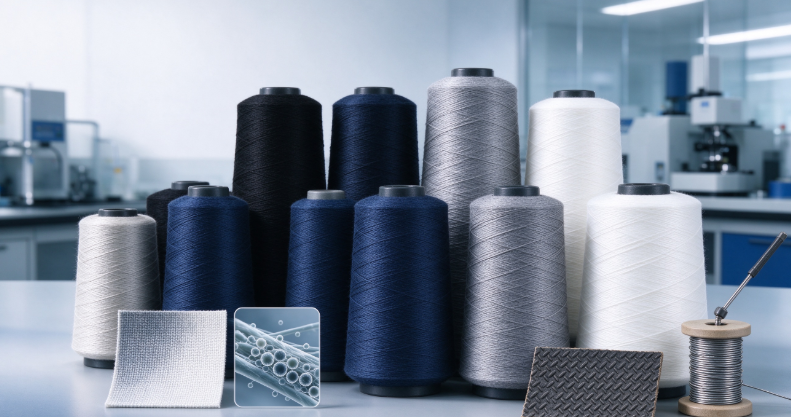
A practical buyer’s guide to selecting count and ply, validating a sample, and preparing a purchase specification.
Define the end use before choosing a count
A useful polyester-spun-yarn purchase starts with a process requirement, not a supplier’s broad label. The count, ply, twist, package, knitting or weaving setup, and finishing route together determine whether a yarn runs well and produces the intended fabric. Yizheng Tianrun Textile’s public catalogue lists 100% polyester staple-spun yarn from 10s to 60s, with single, two-ply, and three-ply constructions [1]. These are the published range options; the site does not publish a complete tolerance sheet for every count, so buyers should confirm the count system and technical limits on the quotation and sample.
This guide explains how to compare options, prepare a clear RFQ, and run a practical trial before committing to a production lot. It focuses on the selection decisions that most often affect downstream efficiency: linear density, yarn construction, end-use performance, machine compatibility, and lot-to-lot documentation. The keyword 100% polyester spun yarn describes fiber composition and spinning form, but it does not by itself define a yarn’s full performance or suitability.
Start by writing down the fabric or product target. A fine apparel knit, a woven bag fabric, sewing thread, footwear textile, and a tire-related reinforcement application do not impose the same balance of strength, handle, abrasion resistance, surface appearance, or processing stability. State the end use, target fabric weight or construction if known, machine gauge or loom setup, and any finishing or dyeing steps. If the yarn is for a product with a defined performance specification, attach that specification rather than asking a supplier to infer it from the application name.
Separate yarn count from ply
Next, separate count from ply. Count identifies yarn fineness under a specified numbering system; ply describes how many component yarns are combined. A two-ply product is not automatically equivalent to a single yarn at twice the count: twist level, component balance, and resulting structure also matter. Tianrun’s 30s page lists 30/1, 30/2, and 30/3 options [2]. That demonstrates the available construction choices, but does not establish that a given 30/2 product will replace every competitor’s 30/2 without machine and fabric trials.
Convert count into a comparable specification
The ‘s’ suffix is not enough to calculate a guaranteed tex value unless the count convention is agreed. If the supplier confirms English cotton count (Ne), a common planning conversion is tex ≈ 590.5 ÷ Ne. The following values are mathematical equivalents for comparison only, not Tianrun-certified specifications. Confirm the actual numbering system, test method, and tolerance in writing before using a conversion for costing or machine settings.
Published Tianrun count range and illustrative Ne-to-tex planning equivalents
Catalogue count | Listed ply options | Approx. tex if count is Ne* |
10s | 1 / 2 / 3 ply | 59.1 |
20s | 1 / 2 / 3 ply | 29.5 |
30s | 1 / 2 / 3 ply | 19.7 |
40s | 1 / 2 / 3 ply | 14.8 |
50s | 1 / 2 / 3 ply | 11.8 |
60s | 1 / 2 / 3 ply | 9.8 |
*The tex column is a calculation using 590.5 ÷ Ne, rounded to one decimal. It is not a supplier test result. The website presents counts with “s”; confirm the count convention before applying this conversion. The published product pages show all three ply options across the count family.
Match construction to the machine trial
Ply should be selected against the process and finished product. A single yarn can be appropriate where a lighter linear density or a particular fabric hand is needed. Plying can change handling, roundness, cover, and resistance to twist-related snarling, but the actual result depends on component yarn and ply twist. Ask for the twist direction and turns per metre only when they are important to the design, then request the measured value and tolerance. The supplier’s page describes high strength and low elongation as attributes but does not provide numeric limits, so these need to be confirmed against a sample or inspection report.
Build a useful sample approval
A sample approval should be more than a visual check of a cone. Record the exact count, ply, color or natural state, package type, net mass, lot identifier, and machine settings used in the trial. Run enough material to observe startup, steady-state operation, and package changeover. For knitting, monitor end breaks, needle cleanliness, fabric bars, and surface consistency. For weaving, watch warp breakage, shedding, abrasion at guides, and shed formation. These are process observations, not universal acceptance thresholds; set numeric limits based on the buyer’s own equipment and quality plan.
Send a complete yarn RFQ
A well-structured RFQ helps a 100% polyester spun yarn manufacturer quote the same product the buyer intends to test. Identify the base count and system, single or ply construction, intended process, end use, required color, package details, order volume, destination, and inspection documents. Ask whether the requested product is standard or custom. Tianrun’s website says standard counts cover 10s through 60s, and that custom specifications can be discussed. Treat a nonstandard count as a development request until a sample and specification are approved.
Control documents for repeat orders
Before production, align the paperwork. A purchase specification should state the sampling plan, test methods, acceptance values, packaging and labeling, and change-control process. If a supplier’s report lists only ‘pass,’ ask for the measured value, units, method, date, and lot number. Keep the approved sample and a sealed reference package where practical. For repeat orders, compare the new shipment with the approved reference under the same conditioning and test protocol rather than relying on a memory of the first run.
The practical outcome is a controlled choice: choose count for the target fineness, choose ply for the required structure and handling, then verify performance on the intended machine. That procedure makes supplier comparisons clearer and helps avoid costly substitutions based only on a similar product name. For buyers searching for a 100% polyester spun yarn supplier for knitting or weaving, a concise technical RFQ and a documented trial are more useful than an unsupported claim of universal compatibility.
Frequently Asked Questions
Is 100% polyester spun yarn always suitable for apparel?
No. Fiber composition alone does not guarantee a suitable hand, strength, pilling result, dye response, or machine performance. Match the specification to the fabric and validate a sample.
What does 30/2 mean?
It commonly denotes two plies made from a 30-count component, but the count convention and twist construction must be confirmed with the supplier.
Can the published count range be converted directly to tex?
Only after the count system is confirmed. The example table assumes Ne and is for planning; obtain the supplier’s stated linear density, method, and tolerance for purchasing.
Article body and table: 1095 words