
Plied Yarn Explained: How Ply Construction Changes Strength, Balance and Cost
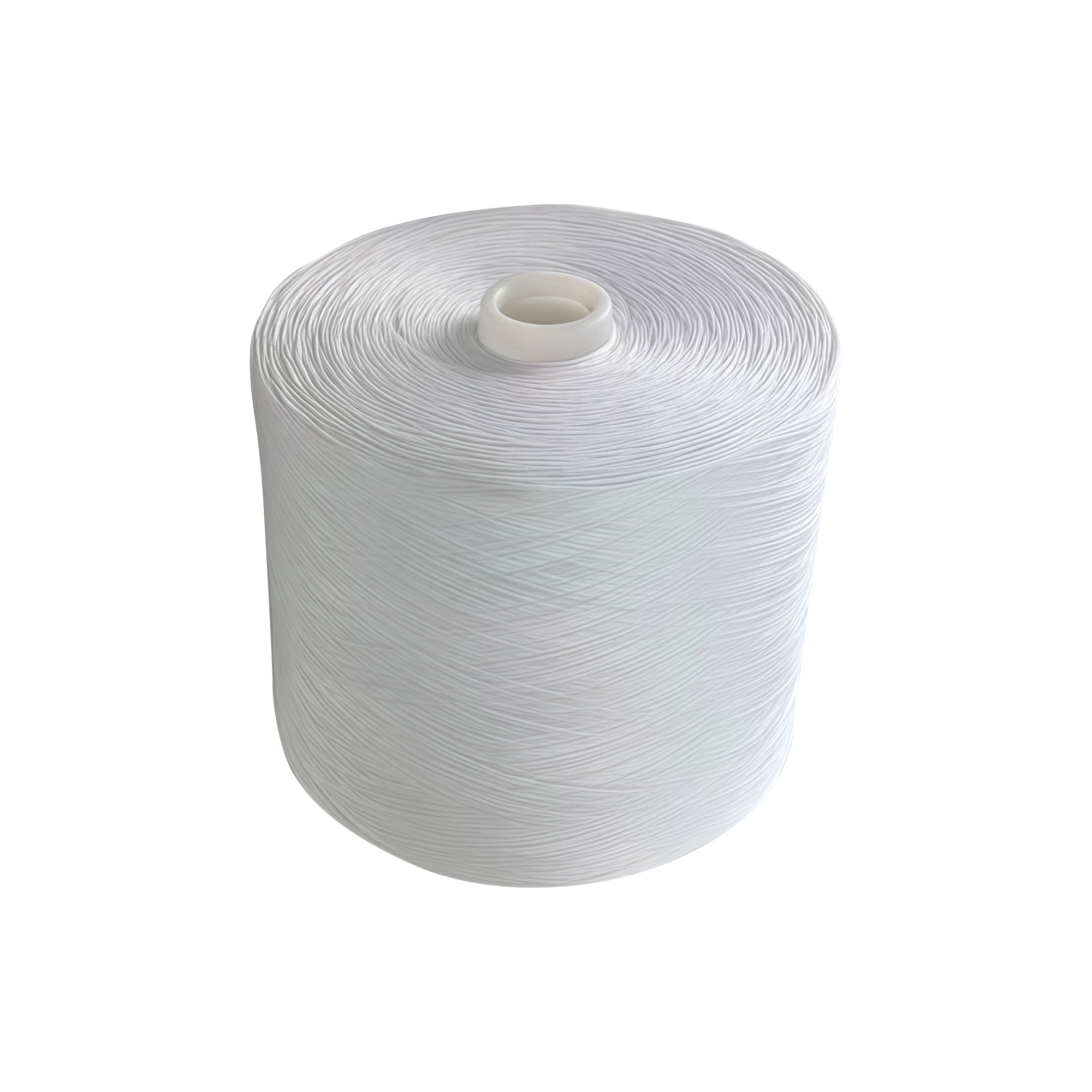
What plied yarn is, and why the distinction matters at purchase
Plied yarn is made by twisting two or more already-spun single yarns together. The single yarns are the building blocks; the plying operation combines them into one larger, more balanced strand. In a polyester staple-spun supply chain, that difference is not cosmetic. It changes tensile behaviour, surface evenness, twist balance, winding performance and cost per kilogram, and it changes what you must write on a purchase specification to get a repeatable result.
The notation is the first thing to read correctly. A count such as 20/2 means a 20s single yarn that has been two-plied; 20/3 means a 20s single yarn three-plied. The first number describes the single yarn's count, not the finished plied yarn's. A 20/2 is therefore a heavier finished strand than a 20/1, roughly twice the linear density before allowances for plying take-up, and it behaves as a different product on the machine. Suppliers of 100% polyester staple-spun yarn commonly offer the same base count in single, two-ply and three-ply form, for example 10/1, 10/2 and 10/3 or 30/1, 30/2 and 30/3, so the ply decision can be made independently of the count decision.
How plying changes the yarn: mechanism, not marketing
Twist balance and liveliness
A single yarn carries twist in one direction, which stores torque. When that yarn is allowed to relax, it tends to snarl, kink or loop. Plying twists two or more singles together in the opposite direction, so the torque of the components partly cancels. The practical result is a calmer yarn that lies flatter, winds more evenly and is less prone to pigtail or loop formation during unwinding. This is why plied constructions are often chosen where the yarn must run at tension through guides, needles or knitting elements without generating defects.
Balance is a matter of degree, not a binary. A plied yarn can still be over-twisted or under-twisted relative to its intended use, and the balance depends on the ratio of single twist to ply twist as well as on the ply twist level itself. Ask the supplier what ply twist direction and level the yarn is made to, and confirm it on the sample rather than assuming that "plied" automatically means balanced.
Strength and elongation
Plying generally improves tensile performance relative to a single yarn of the same finished linear density, because the load is shared across parallel components and the ply twist distributes stress more evenly. It also tends to reduce the effect of a thin or weak spot in any one single yarn, since neighbouring plies carry the load across that point. The gain is real but not unlimited: excessive ply twist can reduce elongation and make the yarn stiffer, while too little ply twist allows the components to separate or slip under abrasion.
For buyers, the useful framing is that ply construction is a lever on strength, elongation and uniformity, and the lever has an optimum. High strength and low elongation are properties a supplier may state for its polyester spun range, but the specific values that matter are the ones measured on the lot you will receive. Ask for the test method and the acceptance range, not just a descriptive phrase.
Evenness and appearance
Plying averages out some of the mass variation present in the individual singles, so plied yarns often look and measure more even than the singles they are built from. In fabrics and cords this can translate into fewer thick-and-thin bands and a more consistent surface. It does not remove contamination, neps or colour variation, and it will not correct a single yarn that is fundamentally outside its count tolerance.
Reading the trade-off: single, two-ply or three-ply
The table below compares the three constructions on the factors that usually drive a purchasing decision. It describes general tendencies in staple-spun polyester; the actual numbers depend on the count, twist levels and process control of the specific supplier.
| Factor | Single yarn (e.g. 20/1) | Two-ply (e.g. 20/2) | Three-ply (e.g. 20/3) |
|---|---|---|---|
| Finished linear density | Base | Approximately double the single | Approximately triple the single |
| Twist balance | Torque stored in one direction; livelier | Largely counter-balanced | Largely counter-balanced; heavier strand |
| Strength per unit density | Lower; sensitive to thin places | Higher; weak spots bridged by the second ply | Higher still, with diminishing returns |
| Evenness | Reflects the single directly | Improved by averaging | Improved further |
| Handling and winding | Prone to snarl if relaxed | Calmer, better for high-tension paths | Calmer but stiffer; check guide and needle compatibility |
| Relative cost per kg | Lowest | Higher: extra singles plus plying step | Highest |
| Typical selection driver | Cost, softness, simple downstream processes | Strength and balance at moderate cost | Heavy-duty cordage, abrasion resistance, thick structures |
Two decision rules follow from this. First, if the problem you are solving is snarling, poor winding or inconsistent tensile results, moving from single to two-ply is usually the cheaper fix than raising the base count. Second, if you need a heavier strand, compare a higher single count against a plied construction of a lower count: both can reach a similar finished density, but they differ in balance, evenness and cost. The plied route typically buys uniformity and calm running; the heavier single typically buys a lower price per kilogram and a softer hand.
Where plied polyester spun yarn is used, and why
Plied constructions appear across apparel, footwear and headwear, toys, bags, tires and sporting goods such as sports balls. The common thread is mechanical demand. Sewing threads, stitched assemblies, corded trims, ball seams and reinforced panels all load the yarn in tension and abrasion, and all benefit from a strand that resists snarling and holds together under repeated flexing. In tire-adjacent and sporting-goods applications, the requirement is usually stated as a strength and elongation target rather than a ply alone, so the ply is a means to a measured end.
Where the downstream process is gentle and cost dominates, a single yarn often remains the right choice. Do not specify plied construction by default; specify it against a failure you are trying to prevent.
Specification checklist for a plied yarn order
A plied yarn purchase order that omits any of the following tends to produce disputes at inspection. Each item corresponds to a measurable property or a process condition.
- Count and ply in the standard notation, for example 10/2 or 30/3, with the base single count stated explicitly to avoid the 20/2-versus-40/1 ambiguity.
- Ply twist direction and level, with the test method and tolerance. Twist direction relative to the single twist is what produces balance.
- Strength and elongation targets with the test method, gauge length and conditioning stated, plus a minimum acceptance value.
- Count tolerance and the method used to verify it, since plied yarns can drift if the singles are outside tolerance before plying.
- Evenness and defect limits: neps, thick places, thin places and contamination, defined by a named method or a visual standard agreed on the sample.
- Package form: cone or cheese, weight per package, winding density and the unwinding direction your machine expects.
- Application and end use, because the same count and ply can be twisted differently for a sewing thread than for a bag-webbing yarn.
- Inspection route: who inspects, against which standard, and whether third-party inspection is required before shipment.
Inspection and verification: what to check on the sample
Sample approval is the cheapest place to catch a ply problem, because ply defects are structural and will repeat across the lot. A practical approval sequence:
- Confirm the construction physically. Untwist a short length and count the component singles. This catches a two-ply supplied against a three-ply order faster than any laboratory test.
- Check twist balance. Hang a free length and observe whether it snarls or rotates strongly. A balanced plied yarn should hang with limited liveliness. Record the behaviour rather than judging it subjectively.
- Measure count and twist on conditioned samples using the method named in the specification, and compare against tolerance.
- Test tensile properties at the agreed gauge length and conditioning, and record both strength and elongation, not strength alone.
- Run a machine trial on the actual downstream equipment. Winding, tension and defect generation at production speed reveal problems that bench tests miss.
- Retain the approved sample as the reference standard for the bulk inspection, with the approval date and the measured values attached.
For bulk, arrange inspection against that retained standard and ask for the technical and inspection reports that accompany the shipment. If the supplier supports third-party inspection, agree the sampling plan and the acceptance criteria before production starts, not after.
Common failure modes and their likely causes
- Ply separation or untwisting at cut ends. Usually insufficient ply twist or a twist direction mismatch; check the ply twist level against the specification.
- Snarling and kinking during unwinding. Often residual torque from an under-balanced construction, or a package wound at the wrong tension.
- Strength below target despite the plied construction. Frequently a single-yarn problem carried through plying: low base strength, count drift or excessive thin places. Plying masks weak spots but does not repair them.
- Stiff hand and low elongation. Usually over-twisting; confirm whether the ply twist was raised to hit a strength target at the expense of elongation.
- Count outside tolerance on the finished yarn. Check whether the singles were verified before plying, since errors compound.
- Contamination or colour variation. Not a ply issue; plying will not correct it, and it should be raised as a separate specification item.
Limits of what plying can do
Plying improves balance, evenness and tensile consistency, but it does not change the fibre. A plied yarn made from polyester staple remains a staple yarn with the moisture, thermal and dyeing behaviour of polyester; plying does not make it a filament yarn, and it does not add properties the fibre lacks. It also adds a process step, so lead time and cost per kilogram rise relative to the equivalent single yarn. Where a specification demands a property outside the fibre's nature, the answer lies in fibre selection or blending, not in adding plies.
Finally, ply count is not a quality grade. A well-made two-ply can outperform a poorly made three-ply on strength consistency and running behaviour. Evaluate the measured properties and the process control behind them, not the number of plies alone.